


How Much Should a Tradie Charge Per Hour
Most Tradies get this wrong from day 1. Here's the calculation that actually tells you the truth
HOW MUCH SHOULD I CHARGE AS A TRADIE?
It's one of the first questions every tradie asks when they go out on their own. And almost everyone gets the answer wrong not because they're bad at their trade, but because they're solving the wrong problem.
The common approach goes something like this: "What's a fair rate? Maybe $85 an hour? That feels reasonable." Then out comes the phone calculator. $85 × 40 hours × 52 weeks. $176,800. Sounds pretty good.
THE TRAP MOST TRADIES FALL INTO:

The problem isn't the hourly rate. It's the assumptions behind it. You won't work 40 billable hours a week. You won't work 52 weeks a year. And that $176,800 doesn't account for a single dollar of running costs. By the time reality hits, you're chasing your tail and you can never quite get in front of it.
Here's a better way to think about it. Start from the end and work backwards.
Start With What You Actually Want to Earn
Before anything else, ask yourself: what would I earn as a skilled employee of someone else's business? Let's say that number is $120,000 a year.
Now ask: if I'm going to take on all the stress, risk, and admin of running my own business, what's the premium I need for that to be worth it? At minimum, 25% more. That brings your target to around $155,000 net money in your pocket after tax, before business costs.
The core principle: Don't start with an hourly rate and hope the money works out. Start with what you need to earn then reverse engineer the rate that gets you there.
Calculate your Real Running Costs
This is where most tradies are vague and vague is expensive. Sit down and map out every cost of running your business for a year. Don't rush it. Take the time to be thorough.
This includes:
Vehicle repayments, fuel, registration, servicing
Tools and equipment purchases, repairs, replacements
Insurance public liability, income protection, vehicle
Accounting and bookkeeping fees
Phone, software, subscriptions
Marketing or advertising
Licenses, registrations, certifications
Superannuation don't forget to pay yourself this
For most sole traders, this number lands somewhere between $30,000 and $60,000 a year. For this example, let's use $45,000.
Before anything else, ask yourself: what would I earn as a skilled employee of someone else's business? Let's say that number is $120,000 a year.
Now ask: if I'm going to take on all the stress, risk, and admin of running my own business, what's the premium I need for that to be worth it? At minimum, 25% more. That brings your target to around $155,000 net money in your pocket after tax, before business costs.
Calculate your Actual Billable Hours
This is the number that surprises people most. You might think you're working 40 hours a week but how many of those hours are you actually billing a client for?
Think about what eats into your week:
Travel between jobs
Quoting and admin
Waiting on materials or access
Running to the supplier mid-job
Weather delays
Chasing invoices
For many tradies especially those doing smaller jobs or repair work real billable hours are closer to 20 to 25 hours a week, not 40. And that's before you factor in annual leave, public holidays, sick days, and the inevitable slow weeks.
A conservative but realistic figure: 20 billable hours per week, across 45 working weeks per year..
Now Do the Calculation
With those numbers in hand, the maths is straightforward:
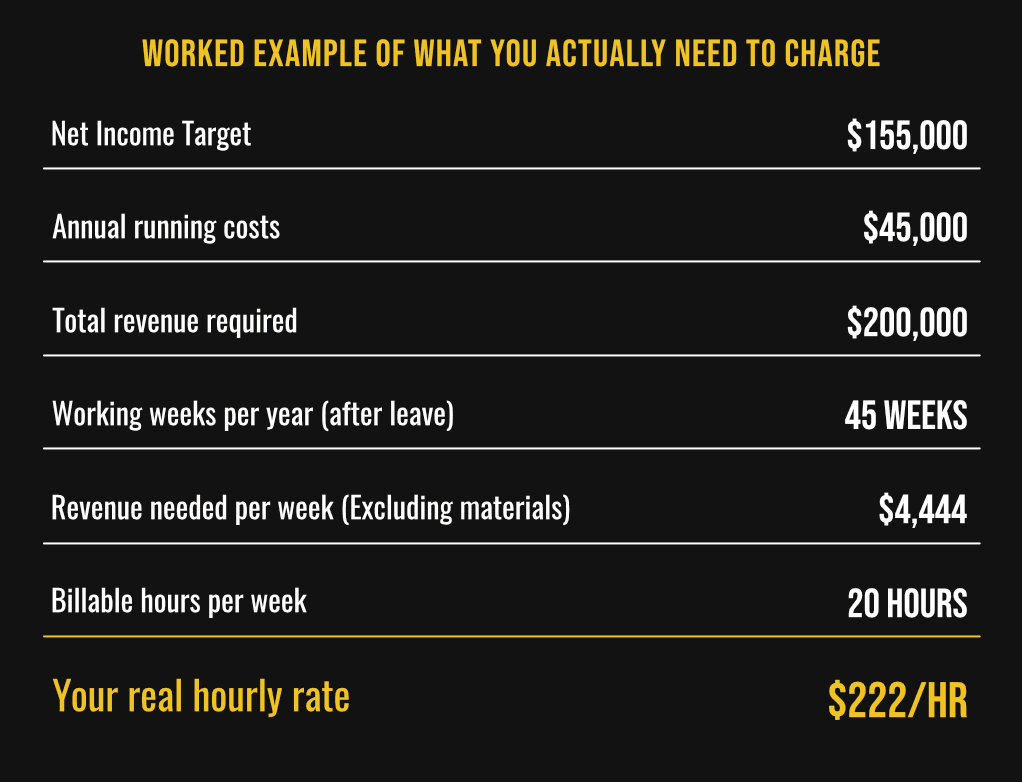
Two hundred and twenty-two dollars an hour. Not $85. Not $110. $222 just to hit a modest income target with realistic assumptions.
That's not a luxury rate. That's what the numbers actually require when you account for how a trade business really operates.
If you're charging $85 an hour and working flat out, you're not building a business. You're subsidising your customers and running yourself into the ground doing it.

