


How Much Should a Plumber Charge Per Hour?
Most plumbers base their hourly rate on what other plumbers charge instead of what their own business actually needs to earn
Most Plumbers get this wrong.
It’s one of the first questions every plumber asks when they go out on their own.
“What should I charge per hour?”
Most people start by looking at what other plumbers charge. Maybe it’s $100 an hour. Maybe it’s $120. If everyone else seems to be charging it, it must be about right.
The problem is that none of those plumbers know what your business costs to run.
The Problem With Charging $100 per Hour

THE MYTH: $100 × 40 hours × 52 weeks = $208,000
Sounds great.
Except almost nobody gets anywhere near it.
The problem isn’t the hourly rate.
It’s the assumptions.
You won’t bill 40 hours every week.
You’ll be driving between jobs, quoting work, collecting materials, waiting on customers, chasing invoices, managing suppliers and handling paperwork.
Most plumbers spend far more time working than they spend billing.
That’s why it’s better to start with what you actually want to earn, then work backwards.
Step 1 : Decide What You Want To Earn
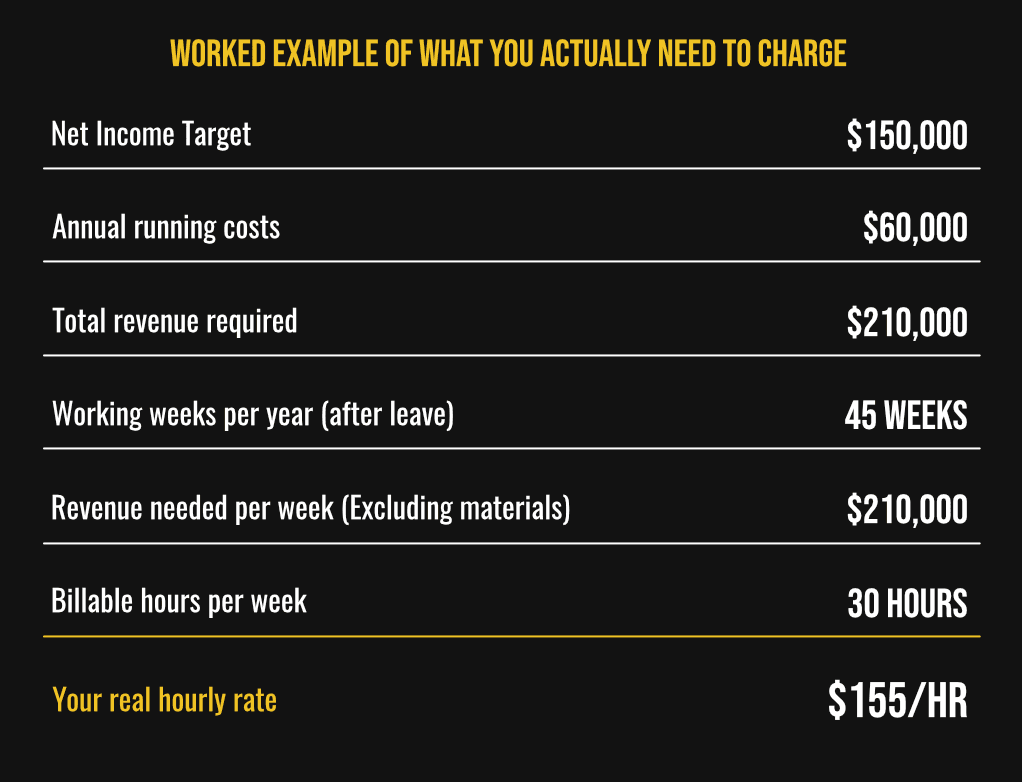
Let’s assume your goal is to put $150,000 a year in your own pocket.
That’s a solid income for a plumber taking on the risk of running their own business.
Now we work backwards from there.
Step 2 : Calculate Your Running Costs
This is where most plumbers become vague.
Don’t.
Write down everything it costs to keep your business operating.
Typical annual costs might include:
Vehicle expenses (fuel, servicing, registration, insurance)
Tools and equipment
Public liability insurance
Accountant and bookkeeping
Phone and software
Marketing and advertising
Licences and registrations
Office expenses
Superannuation
For many sole-trader plumbers, annual running costs end up somewhere between $50,000 and $70,000.
For this example we’ll use:
Annual business costs: $60,000
Step 3 : Work Out Your Real Billable Hours
This surprises almost everyone.
You might work 50 hours a week.
That doesn’t mean you bill 50 hours.
Think about everything that happens between jobs:
Driving
Quoting
Picking up materials
Customer calls
Admin
Ordering stock
Chasing payments
Realistically, many plumbers only bill around 25–30 hours each week.
We’ll use:
30 billable hours per week
45 working weeks per year
That gives us:
1,350 billable hours per year.
Now Do the Maths
Why Most Plumbers Still Undercharge
This is where most plumbers get caught.
They don’t calculate their own number.
They ask another plumber.
Or they ask Facebook.
Or they charge whatever feels reasonable.
None of those methods tell you what your business needs to survive.
Your hourly rate should never be based on what someone else charges.
It should be based on what your business actually costs to run.

