


How Much Should a Roofer Charge Per Hour?
Most roofers base their hourly rate on what other roofers charge instead of what their own business actually needs to earn
Most Roofers get this wrong.
It’s one of the first questions every roofing contractor asks when they go out on their own.
“What should I be charging?”
Most roofers look at what everyone else is charging. Maybe it’s $90 an hour. Maybe it’s $120. If that’s what everyone else is quoting, surely it’s about right.
The problem is that none of those roofers know what your business costs to run.
Looking For The Short Answer?
For many self-employed roofers in Australia, the real number is somewhere between $160 and $220 per hour.
Your exact rate depends on your overheads, billable hours and income target, but it’s almost always higher than most roofing contractors expect.
Here’s how to calculate it properly.
The Problem With Charging $120 per Hour
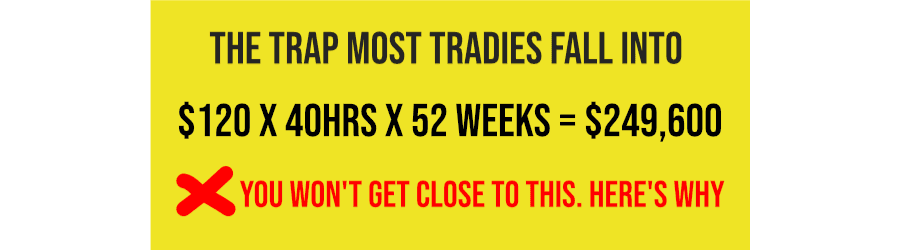
Looks fantastic. Except almost nobody earns that. The problem isn’t your hourly rate.
It’s the assumptions. You’re not billing 40 hours every week.
You’ll lose time quoting jobs, ordering materials, setting up safety equipment, waiting on weather, driving between jobs, collecting supplies and cleaning up.
Most roofers work far more hours than they invoice.
That’s why it’s better to start with what you actually want to earn, then work backwards.
Step 1 : Decide What You Want To Earn
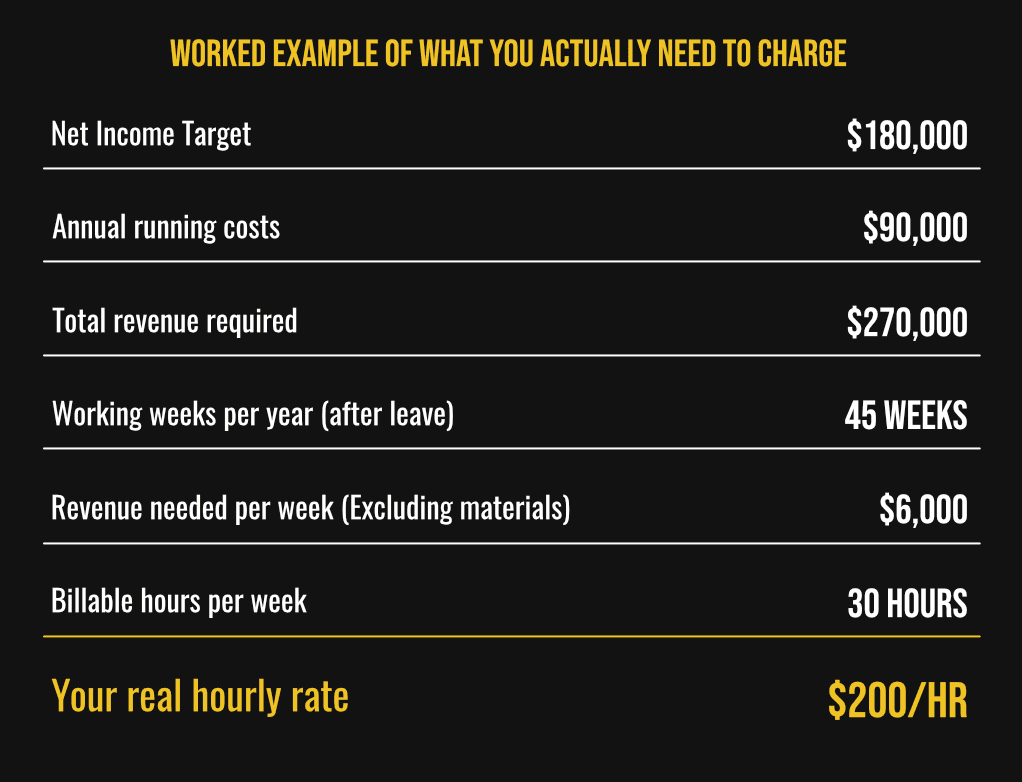
Let’s assume your goal is to put $180,000 a year in your own pocket.
That’s a fair reward for the risk, responsibility and physical nature of running a roofing business.
Now work backwards
Step 2 : Calculate Your Running Costs
This is where many roofing businesses underestimate their expenses.
Write down everything.
Typical annual costs include:
Fuel and vehicle expenses
Public liability insurance
Vehicle servicing and registration
Tools and equipment
Harnesses and safety gear
Ladders and roof access equipment
Accountant and bookkeeping
Phone and software
Marketing and advertising
Skip bins and waste disposal
Licences and compliance
For many roofing businesses, annual overheads can easily reach $80,000–$100,000.
For this example we’ll use:
Annual business costs: $90,000
Step 3 : Work Out Your Real Billable Hours
This catches almost every roofer out.
You might leave home at 6:30am and get back at 5:30pm.
That doesn’t mean you’ve billed ten hours.
Think about everything that happens before and after the actual roofing work.
Loading materials
Collecting supplies
Setting up access equipment
Safety checks
Quoting new work
Weather delays
Travelling between jobs
Realistically, many roofing businesses only bill around 28–30 hours each week.
We’ll use:
30 billable hours per week
45 working weeks per year
That gives us:
1,350 billable hours per year.
Now Do the Maths
Weather: The Cost Most Roofers Forget
Unlike many trades, roofers don’t just lose time to quoting, travel and paperwork.
They lose days to the weather.
If it’s raining, the roof may be unsafe to work on.
If winds are too strong, working at height becomes dangerous.
During extreme summer heat, productivity drops and some work simply isn’t safe to continue.
You still have vehicle repayments, insurance, wages, advertising and overheads to pay, but your billable hours stop.
It’s one of the biggest reasons roofers can’t compare their hourly rate to other trades.
When you’re calculating what to charge, you need to account for the fact that every year you’ll lose productive time to conditions completely outside your control.
That’s another reason many roofing businesses need a higher hourly rate than they initially expect. You’re not just charging for the hours you work. You’re also recovering the costs of the hours the weather prevents you from working.
Why Most Roofers Still Undercharge
Most roofers don’t calculate their own number.
They ask another roofing contractor. Or they ask in a Facebook group. Or they charge whatever feels reasonable.
None of those methods tell you what your business needs to survive. Your hourly rate should never be based on what another roofer charges.
It should be based on what your business actually costs to run.

